Feeding fodder beet and want to cover the common mineral gaps?
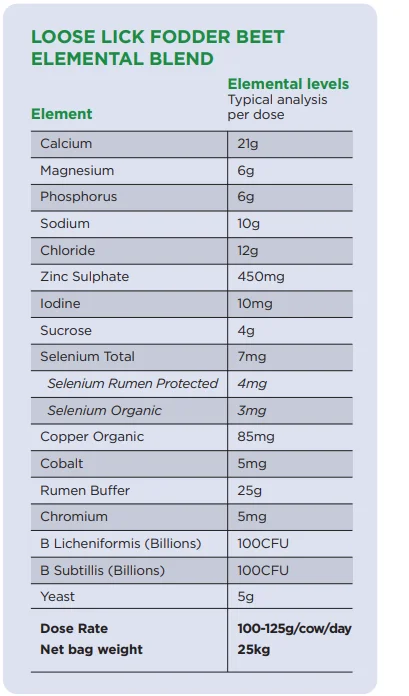
Feeding cattle on fodder beet can create specific mineral issues that need a specialised blend. Premium Fodder Beet Loose Lick is a free-choice stock lick designed for this purpose, providing a balanced mineral supplement for the winter months, with targeted calcium and phosphorus plus trace minerals.
Scientifically-proven benefits and features:
Rumen buffer + yeast support a steady transition and help reduce acidosis risk
Balanced calcium + phosphorus target common deficiencies linked with fodder beet feeding (fodder beet is low in phosphorus, hypocalcaemia risk)
Essential trace minerals support herd health and immunity
Cost-effective, simple free choice option for winter feeding
Your local Agvance Consultant can help you determine the best approach for your herd. Get in touch today to discuss how Premium Fodder Beet Loose Lick can fit into your farm system.
Get the most out of Premium Fodder Beet Loose Lick
Dose rate: 100–125g per cow per day
On-farm trials show cows often settle at about 100g per cow per day over 3–4 days
Intake can shift with weather: Cold, wet conditions may increase intake by 20–40%, warm, dry weather may decrease intake by 20–40%
Feeding setup: Use one 100L container per 100 cows (200L drums cut in half work well). Drill holes in the bottom so water does not accumulate. Top up every 1–2 days
DairyNZ guidance notes fodder beet can be very low in phosphorus and recommends supplementing cows grazing fodder beet with di-calcium phosphate (DCP). (DairyNZ TechNote 13 publisher PDF)
DairyNZ also notes fodder beet is relatively low in calcium and phosphorus, which can limit how much can be fed without extra supplementation. (DairyNZ “Feeding fodder beet” guidance)
A controlled feeding study found adding DCP to the diet increased serum calcium and improved intake, digestibility and milk production in lactating cows. (DOI: 10.1371/journal.pone.0282879)
A 2-year dairy cow study found a higher-phosphorus diet did not improve milk yield or reproductive measures compared with a lower-phosphorus diet that stayed within normal blood phosphorus ranges. (DOI: 10.3168/jds.S0022-0302(00)74969-1)
Limits
These sources support the need to manage calcium and phosphorus supply on fodder beet diets and the use of DCP-type supplementation. They do not test this specific Agvance product or the “dusting” delivery method.
Study details and links
What was tested
Fodder beet feeding guidance on mineral shortfalls (calcium and phosphorus), plus controlled studies comparing diets with and without DCP supplementation, and a longer-term study comparing two dietary phosphorus concentrations.
What was measured
Dietary calcium and phosphorus supply, intake, digestibility, milk yield and composition, blood mineral measures (including serum calcium and serum inorganic phosphorus), plus reproductive measures in the long-term study.
Supplementing dairy feed by dicalcium phosphate and effect on dry matter intake, digestibility, milk composition, and blood mineral balances in crossbred dairy cows, PLOS ONE: DOI 10.1371/journal.pone.0282879 Publisher page: https://journals.plos.org/plosone/article?id=10.1371/journal.pone.0282879
Milk production and reproductive performance of dairy cows fed two concentrations of phosphorus for two years, Journal of Dairy Science: DOI 10.3168/jds.S0022-0302(00)74969-1 PubMed record: https://pubmed.ncbi.nlm.nih.gov/10821580/
More detail on limits
Evidence is strongest for the general approach of meeting calcium and phosphorus requirements on fodder beet-based diets and using DCP-type supplements where the diet is short. It is not specific to CalciPhos Dusting Grade.
Delivery affects consistency. With dusting over pasture or feed, individual intake can vary with feeding setup, pasture conditions and cow access, so results can differ from controlled feeding studies.